Bedroom Materials & Design
Solid-Wood Platform Bed Frames: What to Check Before Choosing Vermont Furniture Designs
A platform bed frame is both a piece of furniture and a working part of the sleep system. Its dimensions, slats, center support and finish matter as much as the wood’s character. Here is how to assess the details—and what to ask Vermont Furniture Designs—before bringing a frame home.
A bed frame occupies an unusual position in a bedroom. It is often the largest piece of furniture, and yet it is asked to disappear: to support the mattress without announcing itself, to look considered without turning the room into a showroom. A solid-wood platform frame can manage both tasks. But the phrase “solid wood” is a beginning, not a verdict. The important questions concern what the frame is made from, how it is assembled, what the mattress requires, and whether its finish and origins meet the buyer’s standards.
That is especially true when considering a maker such as Vermont Furniture Designs. A name can suggest a place, a method, or a sensibility, but it does not by itself establish where timber was harvested, where a piece was built, or what was used to finish it. A careful buyer treats those details as things to verify, rather than qualities to infer. The result is not a more suspicious way to furnish a room. It is simply a more informed one.
Platform beds are appealing partly because they make the arrangement seem uncomplicated: a mattress rests on a frame, and the frame rests on the floor. In practice, that simple outline conceals a small engineering problem. The foundation must carry the combined load of sleepers and mattress, maintain an even plane, and suit the mattress manufacturer’s support requirements. If it fails at one of these jobs, the wood species and finish become secondary matters.
Start with the mattress, not the catalog
Before comparing styles or finishes, find the mattress’s care and warranty documentation. Mattress construction differs: foam, latex, hybrid and innerspring models may specify different kinds of support, slat spacing, center reinforcement or foundation types. There is no universal spacing rule that applies equally to every mattress. The acceptable gap between slats should come from the mattress maker’s instructions, not from a general claim that one frame suits every bed.
This step is easy to postpone because it is not very romantic. But a handsome frame cannot correct a support system that conflicts with the mattress maker’s requirements. If the mattress warranty specifies a maximum distance between slats, compare that figure with the actual spacing of the frame under consideration. Ask whether the stated measurement refers to the gap between slats or their center-to-center distance; those are not interchangeable descriptions.
Also check whether the mattress is designed for a platform base at all. Some mattresses can be used directly on slats; others call for a solid, continuous foundation or a specific type of base. Even where slats are acceptable, the frame may need a center rail and additional legs, particularly in larger sizes. Confirm the requirements in writing and retain the product documentation. It makes a useful reference if the bed is moved, the mattress is replaced, or a warranty question arises.
Dimensions are more than the mattress size
A queen mattress has standard nominal dimensions, as do other common sizes, but the frame’s outer measurements are not necessarily identical to those of the mattress. Rails, legs, headboards and other structural elements can extend beyond the sleeping surface. That extra width or length matters in a small room, near a doorway, or where bedside tables have already claimed their territory.
Ask Vermont Furniture Designs for the frame’s complete exterior dimensions, not only its stated mattress size. Request the height from floor to the top of the slats, and, if applicable, the height of the footboard or headboard. Think about what will fit beneath the bed, whether a vacuum or storage box can pass underneath, and how the mattress height will relate to bedside tables. A platform frame with a low profile can create a calm, grounded look; it can also make getting in and out more difficult for some sleepers.
Room planning should include the path the bed must travel on its way in. Measure stair turns, narrow hallways and the bedroom doorway. A frame that arrives as a single assembled object may present different logistical problems from one built from rails and a headboard on site. Clarify what is delivered, what requires assembly, and whether the assembled dimensions can be managed in your home. A tape measure is a humble instrument, but it has saved many a carefully planned bedroom.
Slats: spacing, strength and attachment
Slats distribute the mattress’s weight across the frame. Their spacing, width, thickness, material and attachment all influence how evenly they support it. A narrow gap may be suitable for many mattresses, while a wider one may not be. Yet spacing alone tells only part of the story: slats also need to resist bending and stay securely seated when the bed is used over time.
Ask for the slat spacing in inches and find out whether the slats are solid wood, engineered wood, or another material. Ask how thick and wide they are, whether they are fixed in place or removable, and how they attach to the side rails. A slat that sits loosely in a shallow recess may behave differently from one fastened securely. The answer should be specific enough to compare with the mattress maker’s instructions.
If the frame uses flexible or sprung slats, ask how their movement is intended to work with the mattress. If it uses a rigid slat system, establish whether the mattress manufacturer permits that configuration. The goal is not to favor one design in the abstract. It is to understand how the frame behaves as a whole and whether that behavior is compatible with the mattress you own or plan to buy.
Center support and weight capacity
A full-size or larger bed often needs more than two side rails and a set of slats. A center rail can help reduce the span across which the slats must carry weight; support legs can transfer that load toward the floor. The exact design varies by frame and size, so look at the specific model rather than assuming that all platform beds are built alike.
Ask whether center support is included for the size you are considering and how many legs support it. Find out whether those legs make firm contact with the floor once the frame is assembled. A center leg that hovers above the floor provides little useful support; a frame placed on an uneven surface may also require adjustment. Follow the maker’s assembly instructions and do not modify the structure without checking whether the change could affect stability or warranty coverage.
Weight capacity deserves the same direct attention. Confirm the maximum load and what it includes: mattress, sleepers and any additional pressure from movement or sitting at the edge. A clearly stated capacity is more useful than an assurance that a bed is “built to last.” If the limit is not published, ask the maker to provide it. A responsible specification helps buyers judge the frame against their needs without guessing.
What “solid wood” does—and does not—tell you
Solid wood is a meaningful description of material, but it does not identify a species, grade, source or construction method. A frame may use different woods for its rails, slats and visible surfaces. That can be entirely sensible, but buyers should know what is where. Ask Vermont Furniture Designs which wood species are used in each major component and whether any parts contain veneers, plywood or other engineered materials.
The species can affect appearance, weight, hardness and the way the surface responds to wear. Grain and color vary naturally, and a photograph may not capture that variation. Ask whether a finish sample is available or whether the maker can describe the range of expected color and grain. If the piece will be placed in a sunny room, you may also want to ask how the finish and wood color typically change with exposure to light.
Construction matters alongside species. Joinery, rail connections, fasteners and the way the slats meet the frame all contribute to stability. Ask how the frame is assembled, whether bolts or other connections may need periodic tightening, and whether replacement slats or hardware can be obtained. A bed is not usually a complicated machine, but it is repeatedly loaded and unloaded, sometimes at 2 a.m., and its connections should be designed with that ordinary use in mind.
Wood sourcing and the meaning of sustainability
The word “sustainable” can describe a real sourcing standard, a broad intention, or simply a pleasant impression. To understand which is meant, ask where the wood comes from, whether the source is documented, and whether the timber is reclaimed, salvaged or newly harvested. Reclaimed wood may keep usable material in circulation, though the term should be accompanied by a clear account of what has been reclaimed and how it was prepared.
If the wood is newly harvested, ask about the forestry practices or sourcing standards that apply. If a certification is mentioned, request the name of the certifying organization and the relevant documentation. A claim that timber is “responsibly sourced” is more useful when it can be connected to a traceable policy or third-party standard. Buyers need not expect a manufacturer to answer every question instantly, but a specific question deserves a specific response.
Origin can also mean where a bed was manufactured, which is not necessarily where the wood grew. Ask where the timber was harvested, processed and assembled. These details are distinct, and a concise product description may not contain them all. The point is not to treat any particular geography as a guarantee of ethical practice; it is to learn the actual chain of decisions behind the piece.
Finishes, stains and adhesives
A natural-looking surface does not reveal its chemistry. Clear finishes, stains and paints can differ in ingredients, application methods and emissions. If those details matter to you, ask what finish is used, whether it is water-based or solvent-based, and whether the manufacturer has information about volatile organic compounds or other relevant emissions. Avoid treating terms such as “natural,” “eco-friendly” or “non-toxic” as self-explanatory; ask what the claim means and how it is supported.
The same curiosity applies to adhesives and composite components. A frame described as solid wood may still include glue in certain joints or constructed elements. Ask whether adhesives are used and whether the maker can provide product or safety information. If you have a specific sensitivity, consult the manufacturer and, where appropriate, a qualified health professional rather than relying on a broad marketing phrase.
Allow time for a newly finished piece to air out according to the maker’s instructions. The recommended period can depend on the finish and its application. Ask whether the bed should be assembled in a ventilated room, whether the finish needs special care, and which cleaning products are appropriate. Following the manufacturer’s guidance can protect both the surface and the frame’s long-term appearance.
Look closely at the details that make a bed livable
A frame can be structurally sound and still be inconvenient in daily use. Check for sharp corners, protruding hardware and rails that extend beyond the mattress. If you sit on the edge of the bed to dress or put on shoes, consider how far the mattress projects and whether the frame offers adequate support in that area. Think about whether the headboard is included, how it attaches, and whether it can be used with your existing bedroom layout.
Noise is another small domestic matter that can become large at night. Ask what steps the maker takes to limit movement at joints and between slats and rails. Proper assembly and a level floor are important, but they cannot compensate for every design issue. If possible, inspect a sample or showroom model; otherwise, ask about the return policy, warranty and what happens if the frame develops a structural problem.
Care instructions should be plain and practical. Find out how to clean the finish, whether water should be avoided, and whether the wood needs occasional treatment. Ask how to move the bed safely and whether disassembly is recommended before relocation. Keeping the instructions with the warranty paperwork is a modest bit of household administration that may prove useful years later.
A frame to consider: the Taconic Bed
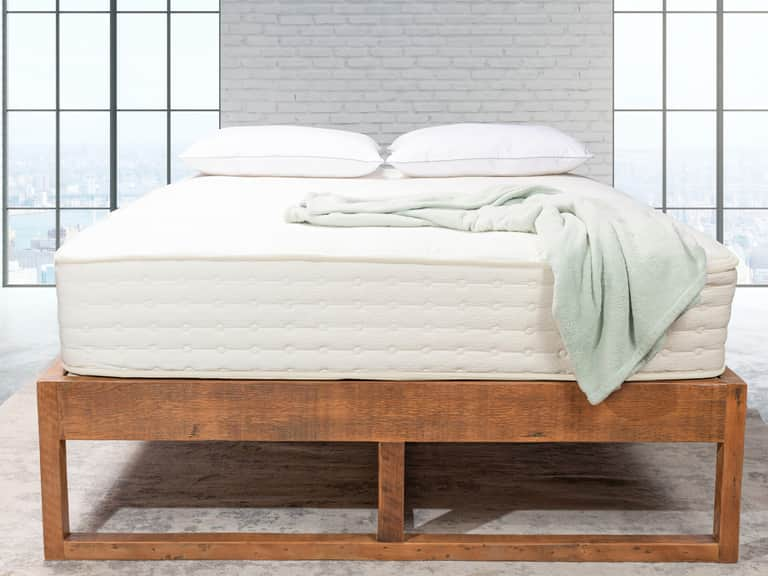
As a point of comparison, The Clean Bedroom Taconic Bed is described as a platform frame handcrafted in the United States from reclaimed wood. Its product information specifies a water-based finish and solid-wood slats positioned no more than 2.5 inches apart. It also describes three finish options: Rustic Raw, Smooth Natural and Double Espresso. Those are useful specifications to compare with a mattress maker’s requirements and with your own preferences for surface appearance and care.
The stated slat spacing is a product detail, not a universal assurance of compatibility. Check it against the documentation for the mattress in question, and ask the seller for any remaining structural specifications you need: exact dimensions, center support by bed size, weight capacity, and information about the wood and finish. The Taconic Bed is not Vermont Furniture Designs; it is simply an example of the kind of information a prospective buyer can look for when evaluating platform frames.
Questions worth asking before you order
A short, well-aimed inquiry can make a product page more useful. Before choosing a frame from Vermont Furniture Designs, consider asking:
- What are the frame’s exterior dimensions and finished height for the size I need?
- What wood species are used for the rails, slats and other structural components?
- Where was the wood harvested, processed and assembled?
- Is the timber reclaimed or newly harvested, and what documentation supports that description?
- What finish, stain, paint or adhesive is used, and is information about emissions available?
- How far apart are the slats, and what are their width, thickness and attachment method?
- Does this size include a center rail and support legs?
- What is the frame’s stated weight capacity, and what does the figure include?
- Which mattress types are compatible, and are there any warranty-related support requirements?
- What are the assembly, maintenance, delivery and warranty terms?
The quiet value of a good fit
Choosing a bed frame does not require turning a bedroom project into an investigation. It does require distinguishing between what is visible and what is known. Grain, color and silhouette are easy to see; slat spacing, sourcing, adhesive details and load capacity may require a question. A thoughtful seller should be able to explain the material and construction choices in language that is clear enough to check.
A solid-wood platform frame can be a durable, expressive part of a room, but good design is not only a matter of appearance. It is a relationship between mattress and foundation, timber and finish, stated claims and supporting details. Begin with the mattress requirements. Measure the room and the frame. Ask how the structure carries weight, what protects the wood, and where the material came from.
Then choose the piece that answers those questions while still making sense in the room you live in. The best bed frame is not necessarily the most imposing or the most elaborately described. It is the one whose construction suits the mattress, whose dimensions suit the space, and whose material story is specific enough for you to make a decision with confidence.