Bedding · Materials Guide
What Wool Comforters Offer—and What Vegan Shoppers Should Know
Wool comforters are prized for warmth, breathability, and their ability to manage moisture. They also come from sheep, which makes them animal-derived and not vegan. Understanding both sides of that equation can help you choose bedding that suits your sleep, your care routine, and your ethical priorities.
A comforter is one of the quieter decisions in a bedroom. It does not announce itself like a mattress or dominate a room like a bed frame. It simply waits, folded back or drawn up, and makes a claim about the night ahead: that it will be warm enough, not too warm, and perhaps still inviting when morning arrives. Wool has earned a place in that small domestic drama because it can insulate while allowing moisture to move away from the body. For many sleepers, this combination feels reassuringly steady.
But a material’s performance is only part of its story. Wool is the fiber of sheep, and a wool-filled comforter is therefore made with an animal-derived material. That fact does not change with a gentle color palette, an organic label, or the promise of an especially comfortable night. For vegan shoppers, the distinction is decisive: wool does not meet vegan criteria. For others, the question may be less categorical, involving sourcing, animal welfare, durability, or personal comfort. The useful place to begin is not with a verdict about what everyone should buy, but with a clear account of what wool offers—and what it asks you to consider.
Why wool feels different
Wool fibers have a naturally crimped structure that traps pockets of air. Those pockets help slow the movement of heat, contributing to insulation without requiring a dense, heavy layer. Wool can also absorb moisture vapor and release it into the surrounding air. In practical terms, this can help a comforter feel less clammy when a sleeper warms up overnight. It is not a thermostat, and it cannot correct every hot-sleeping problem, but its combination of loft and moisture management is a reason people seek it out.
The experience depends on more than the word “wool” on a product page. Fill weight, quilting, the outer fabric, room temperature, sleepwear, and the warmth of other bedding all shape how a comforter performs. A substantial wool fill may feel cosy in a cool room; the same fill may be too warm in a heated apartment or for someone who naturally sleeps hot. A breathable cotton cover can contribute to the overall feel, but it does not make an animal-derived fill vegan. Material choices need to be assessed as a whole, and the fill remains the defining fact here.
Wool’s moisture-handling reputation can also be misunderstood. It does not mean a comforter should be allowed to become damp, nor that it never needs airing or cleaning. It means the fiber can take up some moisture vapor without immediately feeling wet. Good bedding care still matters, as do the manufacturer’s instructions and the conditions of the room. A product described as “naturally breathable” is not a substitute for a suitable warmth level, regular laundering of removable covers, or attention to indoor humidity.
The vegan distinction is straightforward
Veganism excludes animal-derived materials, and wool is one of them. It remains wool whether it is described as natural, washable, small-farm sourced, or certified organic. Those words may describe certain aspects of production, processing, or sourcing, but they do not change the material’s origin. If your aim is to keep animal-derived fibers out of your bedroom, a wool comforter is not an appropriate choice.
That clarity can be useful in a marketplace where ethical language is sometimes blurred. “Natural” is a description of origin, not a synonym for vegan. “Organic” typically concerns particular agricultural or processing standards, depending on the certification and the product components covered. “Hypoallergenic” is not a guarantee that no one will react to a product. And “cruelty-free,” when used in relation to a textile, may require careful scrutiny: shoppers should ask what the claim means and which parts of the supply chain it covers.
Some non-vegan shoppers weigh welfare and sourcing information when considering wool. They may look for details about farms, handling, shearing, and independent standards. These questions are meaningful, but a label should not be treated as a universal assurance of every practice throughout a supply chain. Read the certification’s scope, look for current documentation, and distinguish what a company states from what an independent standard verifies. Even a well-sourced wool product remains animal-derived; the decision about whether that fits your values is personal, but the material classification is not ambiguous.
A product example—and its limits
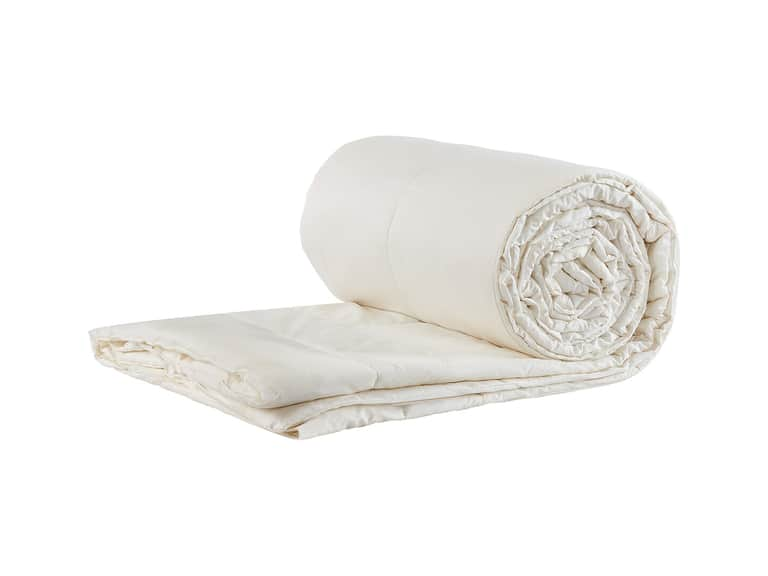
The Sleep and Beyond myComforter is an example of a wool-filled comforter designed around temperature management and a cotton sateen shell. Its product information describes 100% washable wool fill, a cotton cover, and a duvet cover as a way to protect the comforter and reduce the need for cleaning. These features may be relevant to shoppers comparing wool bedding’s construction and upkeep. They do not make the comforter suitable for a vegan bedroom: the fill is wool, an animal-derived fiber.
The product’s care guidance illustrates a broader point about wool comforters. “Washable” does not necessarily mean “wash frequently.” The listed instructions recommend protecting the comforter with a duvet cover, airing it, spot-cleaning when appropriate, and using a gentle wool cycle if machine washing is needed. They also caution against agitation and spinning, and advise following specific drying directions. A care label is more useful than a general assumption about what wool can withstand. Before buying, consider whether the routine fits your laundry equipment, space, and patience.
For vegan shoppers, this example can still serve as a reference point: it shows the performance and care claims commonly associated with wool, while making clear where the ethical boundary lies. The aim is not to dress an animal-derived product up as vegan, or to imply that every sleeper should choose it. It is to compare attributes honestly and then look for an animal-free way to meet the same practical needs.
How to compare animal-free alternatives
Vegan bedding is not one material category but a set of choices. Common comforter fills include polyester, recycled polyester, and other synthetic fibers; some products also use plant-derived materials. Each option has trade-offs in warmth, weight, moisture handling, durability, and end-of-life disposal. A synthetic fill can offer easy-care convenience and a familiar lofty feel, while its environmental profile may depend on the fiber source, manufacturing, longevity, and whether it releases microfibers during use and washing. Plant-based claims also deserve a closer look: check what the fill actually consists of and whether any animal-derived components are present.
Start with how warm you need to be rather than with a material trend. Think about the climate where you sleep, whether your room is heated, whether you share a bed with someone whose temperature preferences differ, and whether you already use flannel sheets or a heavy duvet cover. A lightweight comforter under a removable cover may be more adaptable than a single very warm one. If you tend to overheat, a lighter fill and breathable layers can be more useful than a promise that any particular material will keep you cool.
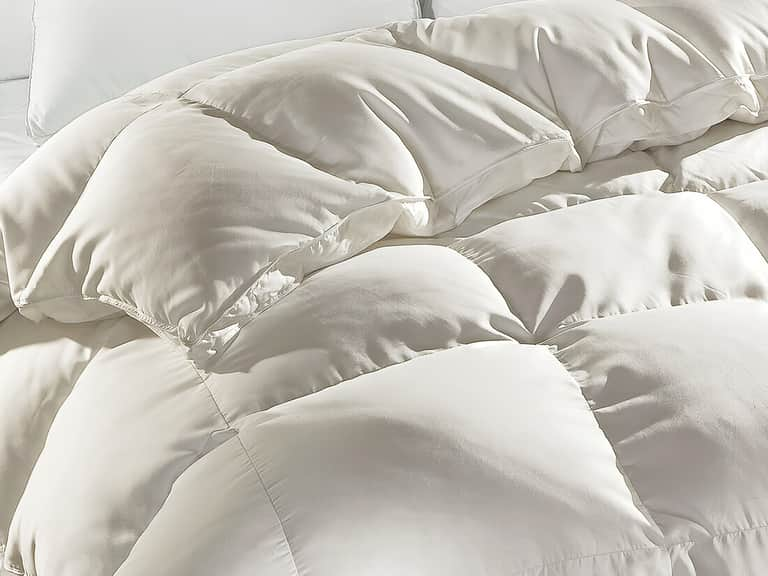
Then inspect the construction. Look for the fill composition, shell material, fill weight or warmth rating, stitch pattern, available sizes, and care instructions. Box or channel construction can help keep fill distributed, though workmanship and actual design matter more than a label alone. Check whether the cover is removable, whether the comforter can be washed at home, and how it should be dried. If the listing says “vegan,” verify that the fill, shell, trim, and any treatments do not contain down, wool, silk, leather, or other animal-derived materials.
- Ask what the fill is. “Alternative down” often refers to a synthetic fill, but product descriptions should state the fiber rather than rely on a broad marketing phrase.
- Check the shell as well as the fill. Cotton, linen, and lyocell are plant- or cellulose-based fibers, but a comforter can combine them with animal-derived insulation.
- Read the care label before checkout. A comforter that requires special cleaning may be a poor match for your routine, even if its material is otherwise appealing.
- Look beyond a single sustainability claim. Ask whether the claim concerns recycled content, organic fiber, chemical testing, or the complete product. These are not interchangeable assurances.
- Consider useful life. A durable comforter that meets your needs for years may be preferable to a cheaper item that quickly loses loft or becomes difficult to care for.
Certifications: useful, but specific
Certifications can make a complicated supply chain easier to examine, but each one has a defined scope. A textile certification may address organic content, chemical restrictions, processing, or workplace and environmental practices. It does not automatically establish that a product is vegan, nor does a certification for one component necessarily cover every part of a finished comforter. When a label matters to your decision, look up what the standard verifies and confirm that the named product—not merely a material used somewhere in it—is covered.
A product may, for instance, pair certified organic cotton with wool fill. The cotton’s certification does not alter the animal origin of the wool. Conversely, an animal-free comforter may have no certification at all, or may carry a standard that addresses chemical testing rather than vegan materials. Labels are best read as answers to particular questions, not as a general score for goodness. The more precise the question—“Is the fill animal-free?” or “What does this certificate cover?”—the more useful the answer tends to be.
Care, longevity, and the room itself
Whatever fill you choose, a duvet cover can help reduce direct contact with body oils, dust, and everyday spills. Washing a cover is usually simpler than laundering a bulky comforter, though instructions vary by fabric. Airing bedding between washes and dealing with stains promptly can also extend its useful life. Do not assume that sunlight, a dryer, or a home washing machine is safe for every material; check the manufacturer’s guidance first.
Storage is another quiet test of a comforter’s longevity. Clean and dry bedding before putting it away, and avoid compressing it for long periods unless the manufacturer says that is acceptable. A breathable storage bag can help protect textiles from dust while allowing some air circulation. If a comforter is no longer usable, investigate textile-reuse or recycling options in your area; disposal routes depend on the material blend and local facilities. A product made from several fibers may be harder to recycle than its packaging suggests.
A calm bedroom does not depend on any one fiber. It depends on layers that suit the sleeper and the room: a comfortable mattress, a pillow with appropriate loft, sheets that feel pleasant against the skin, and a comforter with a workable warmth level. An adjustable bed base, if used, changes the sleeping position rather than the ethical status of the bedding on top of it. The principles are ordinary, which is part of their appeal: buy for the conditions you actually live in, take care of what you own, and let claims earn your trust.
A decision that can be both practical and principled
Wool comforters have a credible appeal. Their fill can provide insulating loft and manage moisture, and some people value the feel and care characteristics of wool. Those benefits are worth understanding, particularly if you are comparing bedding materials or trying to identify why one comforter feels different from another. Yet a clear description of performance should not obscure the question of origin. Wool comes from sheep; a wool comforter is not vegan.
For shoppers who avoid animal-derived fibers, the next step is to compare animal-free fills by warmth, construction, care, and verified material content. You need not accept vague assurances, and you need not settle for a product simply because it is labelled natural. Ask direct questions, inspect the full materials list, and choose a comforter whose care demands and performance fit your life. For shoppers who do consider wool, sourcing and certification research can sharpen the decision, while still leaving the material’s animal origin plain.
The bed is a private place, but its materials arrive with histories attached. Choosing well means making room for both the physical question—will this keep me comfortable?—and the ethical one—does this belong in the home I am trying to create? Wool can answer the first question appealingly for some sleepers. For a vegan bedroom, the answer to the second is no, and there are other materials to explore.